Box Turtle Bulletin
 News and commentary about the anti-gay lobby
“Now you must raise your children up in a world where that union of man and box turtle is on the same legal footing as man and wife…”
News and commentary about the anti-gay lobbyDecember 9th, 2016
 The Spiritual Science Research Foundation (“Bridging the known and unknown worlds”) has discovered the cause of homosexuality for 85% of all gay people:
4.1. Homosexual attraction
The main reason behind the gay orientation of some men is that they are possessed by female ghosts. It is the female ghost in them that is attracted to other men. Conversely the attraction to females experienced by some lesbians is due to the presence of male ghosts in them. The ghost’s consciousness overpowers the person’s normal behaviour to produce the homosexual attraction. Spiritual research has shown that the cause for homosexual preferences lie predominantly in the spiritual realm.
- Physical causes (5%): Due to hormonal changes.
- Psychological causes (10%): Having an experience with a person of the same sex as a teenager or young adult that was pleasurable and therefore wanting to experience it again.
- Spiritual causes (85%): Mainly ghosts
The good news is that chanting should clear that right up. Paging NARTH…
December 8th, 2016

Gee. Ya think?
Mr. Welch, the father of two daughters, said he woke up Sunday morning and told his family he had some things to do. He left “Smallsbury,” a nickname for his hometown, for the 350-mile drive to Washington with the intention of giving the restaurant a “closer look” and then returning home. He wanted to “shine some light on it.” As he made his way to Washington, he felt his “heart breaking over the thought of innocent people suffering.” Once he got to the pizzeria, there was an abrupt change of plans. Mr. Welch would not say why he took a military-style assault rifle inside the restaurant and fired it. According to court documents, Mr. Welch said he had come armed to help rescue the children.
“The intel on this wasn’t 100 percent,” he said. However, he refused to dismiss outright the claims in the online articles, conceding only that there were no children “inside that dwelling.”
The New York Times says that while Welch had at one time registered as a Republican, he said that he didn’t vote for either Trump or Clinton He did say that he was praying that Trump would take the country in “the right direction.” CBS News has more on his background:
Friends and family say he is a well-meaning father of two girls who wanted to be a firefighter. But he also unnerved some with his religious fervor and sometimes had trouble detaching himself from the internet.
In the weeks before his Washington arrest, there were other signs of turbulence. In late October, Welch struck a teenage pedestrian with his car in his hometown, requiring the boy to be airlifted to a hospital, according to a police report that said he wasn’t immediately charged. More recently, days before he drove to Washington, he was dropped from the rolls of a volunteer fire department.
December 6th, 2016
Until #Pizzagate proven to be false, it'll remain a story. The left seems to forget #PodestaEmails and the many "coincidences" tied to it. https://t.co/8HA9y30Yfp
— Michael G Flynn🇺🇸 (@mflynnJR) December 5, 2016
There’s a bombshell out there that the mainstream media has been keeping from you, news so shocking that it has the media and liberal elites working overtime to suppress it. But thanks to Wikileaks and a few fearless news outlets on the internet, the truth is coming out. So all you have to do is Google it to find out more about what’s going on. Or follow Michael Flynn Jr.’s tweets. He knows what he’s talking about. He’s the son of Gen. Michael Flynn, Trump’s national security advisor. The younger Flynn is also his father’s chief of staff and top aide.
 Since the mainstream media has been keeping you in the dark about “Pizzagate,” here it is in a nutshell. According to suspiciously encoded emails posted on Wikileaks from Hillary Clinton’s campaign chair, John Podesta, he and Clinton, along with billionaire donor and convicted pedophile Jeffrey Epstein, other top Democrats and the owner of a Washington, D.C., pizzaria, Comet Ping Pong, are all operating an international pedophile sex trafficking ring and satanic cult. Podesta’s coding in his emails was clever: “hotdog” meant boy, “pizza” meant girl, “cheese” meant little girl, “ice cream” was a male prostitute, “walnut” was a person of color, “map” is semen and “sauce” is orgy. No, I did not make any of that up. (And no, I’m not providing links.) Decoding those emails led to a shocking discovery: Hillary Clinton, when she wasn’t traveling around the country raising money and running for president, was also finding time to kidnap, molest and traffic children and inducing them into satanism in Comet Ping Pong’s back rooms. Alex Jones’ Infowars has been one of the better-known sites flogging the story. Donald Trump had appeared on Alex Jones’s syndicated radio program and praised him for his “amazing” reputation.
The reason the mainstream media has been keeping this news from you is pretty obvious. None of it is true, except that there really is a billionaire donor and convicted pedophile Jeffrey Epstein who, like a lot of billionaire donors, has extensive ties to Trump as well as the Clintons. But conservative fake news sites have been pushing the story since about the beginning of November, as far as I can tell. It appears to also have been popularized by a Pizzagate conspiracy board on Reddit. Reddit has since shut that board down, a move that has a way of sparking even more conspiracy theories.
The fake news surounding Pizzagate has had real world consequences, not just to the rich and powerful but also to ordinary people caught in its crosshairs. Comet Ping Pong’s owner, James Alefantis, received hundreds of death threats the since the whole thing started, and his employees have found their Facebook photos, including photos of their children, plastered on fake news sites. Alefantis has been in contact with the FBI and local police, as well as Facebook, Twitter, YouTube and Reddit, to try to combat the false stories, mostly to no avail. In mid-November, a week after the election, one Pizzagate “citizen investigator” showed up and shot live video during a busy dinner hour inside the kid-friendly restaurant. (The ping-pong portion of the restaurant’s name refers to the ping-pong tables that double as dinner tables.) D.C. police asked him to leave.

Edgar Maddison Welch, fron his Facebook page
But the worst almost happened last Sunday. Twenty-eight-year-old Edgar Maddison Welch traveled from his home to Salisbury, North Carolina, to “self-investigate” Comet Ping Ping. Naturally, his investigative tools included an AR-15 assault rifle. When he entered the crowded pizzeria with the rifle, patrons quickly emptied the restaurant. Welch pointed the gun at a restaurant employee who also fled. Welch fired a shot — no one was hurt — and Welch later surrendered to police.
If these were ordinary times, this would be the end of Pizzagate. These aren’t ordinary times. The Inquisitr is livid that Welch’s actions “undermines citizen investigations.” Others are saying that the whole thing is a false flag, and that Welch is some kind of an actor playing a part in an elaborate plot to discredit Pizzagate.
And so Pizzagate continues to grow. That’s the thing about the post-truth society we find ourselves in. Facts that counter a conspiracy theory get turned around and become fertilizer for it. And our president elect and his minions are enthusiastic supporters of those conspiracies and their proponents. I don’t know about you, but I’m pretty much scared shitless right now.
December 5th, 2016
North Carolina Gov. Pat McCrory, after an acrimonious race, a close election result and unfounded accusations of vast voter fraud, has finally conceded the obvious: he lost, albeit by less than 10,000 votes. His loss come amid national criticism for HB2, which not only banned local nondiscrimination ordinances protecting LGBT people, but went further by requiring transgender people use public rest rooms according to the sex listed on their birth certificate.
McCrory finally conceded defeat in a YouTube video:
“I personally believe that the majority of our citizens have spoken, and we now should do everything we can to support the 75th governor of North Carolina, Roy Cooper. The McCrory administration team will assist in every way to help the new administration make a smooth transition.”
McCrory’s defeat means that, um, only 33 states will be led by Republican governors. Meanwhile, North Carolina’s state legislature remains firmly in Republican hands. Democrats are so weak there that Republicans in both chambers have full reign to override any veto incoming Gov. Roy Cooper may issue.
November 29th, 2016
 Last Friday, James Shawlin went to a Floor and Decor store in the Denver suburbs to return some defective stone slabs that he and his husband had purchased for their fireplace. After an employee gave Shawlin permission to check the replacement boxes of stone before leaving the store, another employee sent the manager over to see what was going on:
“The manager that came over was not too happy,” Shawlin said. “You could tell he was not in a good mood.”
Shawlin said he explained to the manager that another employee had given him permission to look through the boxes.
“I was a little firm with him, and I just told him, ‘hey, you know, my husband and I spend a lot of money here. We’ve been using you guys for ten years. We have $3,000 worth of stone.’” Shawlin said. “And [the manager] goes, ‘oh, that explains it now. The faggot that voted for Hillary.’”
Another customer overheard the manager’s comment and followed Shawlin and his four-year-old son out to the parking lot for more verbal abuse: “He basically said, ‘what are these faggots going to do to this child?’” Shawlin said.
Yesterday, the Atlanta-based retailer issued a statement on Facebook, but that statement has since been removed. According KUSA, the statement read:
On November 25, 2016, we became aware of an unfortunate incident in one of our stores involving two customers and one of our associates. We conducted an internal investigation to determine the facts and took prompt action.
We spoke with the customer the next day and apologized for his experience in our store. We further apologize to his family and the community for what took place. Our ethics code and our employee training make clear we do not tolerate any form of discrimination or harassment based on, but not limited to race, color, religion, age, gender, sexual orientation, national origin, marital status, disability or genetic information. The associate at issue no longer works for us, and we look forward to improving our sensitivity training for all of our employees and providing the highest level of customer service to all members of the communities that we serve.
November 29th, 2016
 A new term has emerged in the press the past few months, and publishers are struggling to come to terms with it. Specifically, how should the identification of the “alt-right” be dealt with? I know I’m not the only one who has had to figure this one out. John Daniszewski, the Associated Press’ Vice President for Standards, has just delivered the organization’s verdict, beginning with a definition:
The “alt-right” or “alternative right” is a name currently embraced by some white supremacists and white nationalists to refer to themselves and their ideology, which emphasizes preserving and protecting the white race in the United States in addition to, or over, other traditional conservative positions such as limited government, low taxes and strict law-and-order.
The movement has been described as a mix of racism, white nationalism and populism.
The AP says you can use “alt-right” in quotation-marks (and lower case) as a part of a quote, or when modified, as in “the so-called alt-right”. A definition for the “alt-right” should also be provided because, as Daniszewski points out, “In the past we have called such beliefs racist, neo-Nazi or white supremacist.” He then provides an example from an AP news report:
With an ideology that’s a mix of racism, white nationalism and old-fashioned populism, the “alt-right” has burst into the collective consciousness since members showed up at the Republican National Convention to celebrate Trump’s nomination last summer.
The AP’s influence in these matters goes far beyond the Associated Press. News rooms across the country use the AP style guide as their go-to guide. And, for the sake of clarity, so will I.
November 21st, 2016

I know I’ve told you about my great-grandmother Easter. She lived a block away from where I grew up in Portsmouth, Ohio. She was born in 1898 in the hollows of Kentucky, and I used to go to her house and ask her to tell me stories about “the olden days.” She was as good as any library to me and I loved spending time with her.
And I know I’ve also told you this story about the time I asked her what the word “hick” meant. I must have heard it somewhere. Maybe I heard it from her. I don’t remember. But I remembered that she answered by describing people who grew up in the hollows of Kentucky, much like she had, but who had never left those hollows and knew nothing about the world around them. They may have thought they knew about the wider world — nobody think’s they’re particularly ignorant, especially now that we had radio, television, movies and newspapers — but, as she said, unless you actually go out into the world, there are things you will never know. Hicks, she said, are people who never left their homes and knew nothing about the world outside of their tiny communities.
And then she stopped and thought about it a bit, and added, “You can find them back in the hollows, but you can also find them in some mighty fancy places. You can even find them in New York City.”
I’ve been thinking an awful lot about that lately. Two weeks after Donald Trump’s surprise election, I’ve been seeing various posts pop up in my Facebook and Twitter feeds and in following some of the discussions taking place in private email listservs of progressive activists. And their simplistic explanations for what went wrong in the election tell me that they are hicks, at least as Easter defined them. But since the word “hick” conjures a very particular pejorative image, I’ll discard it and coin another one that I think is more accurate: Blue Bubble Democrats.

Portsmouth, Ohio, my home town. This is the remnants of the coke plant. (Coke is an industrial fuel made from coal.) It was replaced with a Wal-Mart.
To be clear, you don’t actually have to be in a geographic blue bubble to be a Blue Bubble Democrat. You can easily do this by building your bubble through social media, carefully culled friends, and the particular neighborhoods you chose to call home. And also to be clear, there’s nothing sinister about it. It’s not a moral failing. In fact, it’s perfectly natural. We all do it. I’m in a rather nice blue bubble myself right here in blood red Arizona. But I’ve long recognized that this bubble exists and I’ve worked hard to stepped out of it, and I think I’ve recognized some disturbing trends that I think an awful lot of Blue Bubble Democrats have been ignoring for far too long.
So who are these Blue Bubble Democrats? Well, you can know them by their reaction to this month’s general election. They are the ones who, outraged over the abandonment of the Democratic party by blue collar Americans, are condemning and dismissing them as horribly racist, hopelessly xenophobic and congenitally homophobic. Their solution seems to be, as far as I can tell, to yell at those workers, demand that they stop voting against their interests, check their white privilege, and just generally get over themselves.

An abandoned school in Coal Grove, Ohio, near my home town.
And don’t get me wrong: many blue collar/white middle class Americans are racists. Maybe very many them are. I’d be perfectly stupid to argue otherwise. But let’s be honest here: not all of them are. Not even close. And think about it: those who are would never have voted for a Democrat even if Jesus Christ himself were the nominee. They certainly wouldn’t have voted for a Black man in 2008, and they wouldn’t have voted for a man they branded a Black Muslim Kenyan in 2012. These aren’t the voters who swung this election. They were already in the bag for Trump, just like they were there for Romney, McCain, Bush, and so forth all the way back to Nixon’s “southern strategy” which, truth be told, held an awful lot of appeal outside the South.
Racism was the most visible part of Trump’s campaign. It was visible because it was so shocking, and we reacted strongly (and rightly) to that shock. Neo-nazis, White nationalists and Klanners have openly rejoiced over having “one of our own” running for President. And Trump’s playing to the more sinister impulses of hatred has emboldened them, and more than a few others, to unleash a wave of attacks both before and especially immediately after the election, as we’ve documented here at BTB. We’re all rightly alarmed by it, and we will continue to call it out, as we should.
But while focusing all our outrage in that, we should have been also paying attention to the twin ravages of long term economic crisis and ballooning heroin epidemic in Middle America. In fact, that epidemic should have been our canary in the proverbial coal mines. Instead we just said we’d shut them all down.
And so millions of other blue collar, white working class Americans — who voted for a Black man, and who returned to vote for that Black Muslim Kenyan, turned to Trump. If you’re going to say their vote was all about racism, then you’re going to have to explain why they waited so long to act on it.

Downtown Waverly, Ohio, also near my home town.
Before I leave the subject of racism (and Islamophobia, xenophobia, homophobia, and so forth), I do think it’s fair to ask how they could have excused Trump’s racism. Shouldn’t that have been a disqualifying factor in and of itself? My answer is yes, obviously. I voted for Clinton even though I strongly felt that she was, without a doubt, the single most flawed candidate the Democratic Party’s establishment could have put forward. (I also didn’t support Sanders either. I was beyond dismayed.) I’ll rant more about Clinton later, maybe, but getting back to that question: yes, I think Trump’s racism, Islamophobia, xenophobia, misogyny, homophobia — the list goes on far too long — should have been disqualifying on its face.

Youngstown, Ohio. Detroit gets the attention. This is Ohio’s Detroit.
But I have the luxury of setting those priorities. Many of those who supported Obama but went with Trump didn’t feel they could do that. For decades, they had been telling Democrats that they have been facing an unrelenting economic crisis, in many places for decades without letup. To compound that misery, many of those once-prosperous communities along America’s rust belt are now being consumed by a disastrous opioid and heroin epidemic that is, each year, setting new records for killing their kids. Kirk Noden describes their reaction:
Deindustrialization was a traumatic experience for white working-class people. Yet we act surprised when this constituency exhibits post-traumatic-stress disorder. And it is we who perpetrate the myth that they are voting “against their interests,” despite all the facts on the ground indicating that for them it makes no difference which party is in power. They have lived through 40 years of decline.

Mingo Junction, Ohio, where Appalachia meets the rust belt.
Progressives like to talk about the “erasure” of long-suffering groups from public discourse. There’s trans-erasure, bi-erasure, Latinx-erasure, and so forth. But I haven’t seen anyone talk about another erasure that’s been taking place. Blue collar middle-class Americans had been the bedrock of the Democratic party since the days of FDR. The Democratic party, which had once been the workers’ party, has studiously set about erasing this core constituency from among its ranks as soon as Bill Clinton entered office and his fellow New Democrats and their “third way” took over the party. Former MSNBC host Krystal Ball illustrates the problem: “There was an incredibly revealing moment at the DNC. In an effort to rev up the crowd one of the speakers called out: ‘Who in this room works with their hands?’ Silence.”
Democrats who have been active participants in the erasure of one of their core constituencies cannot be allowed to escape their responsibility for helping to bring about Trump’s victory. Ball, who now lives in Kentucky, has diagnosed the problem quite succinctly:
They said they were facing an economic apocalypse, we offered “retraining” and complained about their white privilege. Is it any wonder we lost? One after another, the dispatches came back from the provinces. The coal mines are gone, the steel mills are closed, the drugs are rampant, the towns are decimated and everywhere you look depression, despair, fear. In the face of Trump’s willingness to boldly proclaim without facts or evidence that he would bring the good times back, we offered a tepid gallows logic. Well, those jobs are actually gone for good, we knowingly told them. And we offered a fantastical non-solution. We will retrain you for good jobs! Never mind that these “good jobs” didn’t exist in East Kentucky or Cleveland. And as a final insult, we lectured a struggling people watching their kids die of drug overdoses about their white privilege. Can you blame them for calling bullshit?
… The arrogance of thinking that somehow we could ignore most of the country and still hold a claim on the nation’s highest office is breathtaking. Demographics are not destiny. Candidates do matter. And it is still the economy, stupid.

Lorain, Ohio
So to those who cling to the idea that racism and the other -isms and -phobias were the reason voters turned to Trump, I challenge them to undergo this simple experiment. Grab one of those county-by-county maps showing the red expanse and the blue bubbles. Drive out from those bubbles (if that’s where you happen to live, or get away from whatever bubble you’ve made for yourself). Get in the car and go out into the red. Go to a bright red county seat and get out of the car. Get off of Facebook and take your earbuds out. Look around. And tell me: what do you see?
Closed storefronts. Abandoned houses and empty lots where whole neighborhoods once stood. Crumbling factory buildings, boarded up schools that were once the pride of the community. Look around. You have to ask yourself, what are these people clinging to?

Lorain, Ohio, when it was great.
Well it turns out that many of those who live in these communities have been looking around and asking the same question. They saw their broken communities, abandoned by the very party that had once been their champion, and heard Trump say he was going to make America great again. Clinton countered that America was already great. They looked around again and said, no, it doesn’t look so great to me.
And then they voted.
Over the course of the next several posts on this subject, we’ll be taking a tour of some of those places that had turned out for Obama but voted for Trump.
November 16th, 2016
Yesterday I told you about the threat made by the Baptist General Convention of Texas to expell two LGBT-affirming Baptist churches from the general convention. One of those churches, Dallas’s Wilshire Baptist Church, was still voting and tabulating the results of its congregational vote on a resolution that “would permit all members to participate in congregational life on the same basis as any other church member regardless of sexual orientation or gender identity. This affirms the ability of the church’s committees and lay and staff governance structures to consider all members for leadership, ordination, baby dedication and marriage based upon individual merit and the discernment of those duly elected to governance positions.” Wilshire was due to release the results of that vote yesterday. Now, WFAA-TV in Dallas reports:

Wilshire Baptist Church, Dallas
Wilshire Baptist Church has voted to grant gays and lesbians full membership to the church, which would allow them to be considered for leadership positions, and grant same sex marriages.
The resolution passed by a 61 percent majority in a final vote which was released on Monday afternoon.
“We want to normalize life as quickly as possible for LGBT folk. And this is not a one-issue church. It’s a church and we’re simply saying the Gospel is open to all and closed to none,” said Senior Pastor George Mason said of the congregational vote.
Of the 948 ballots cast, 577 voted in favor, 367 were against it, and four people abstained.
…”Our church knows that there are consequences of our decision,” Mason said. “We think there will be many positive consequences for being able to say to the LGBT community that they are welcome here fully, in Christ.”
The Dallas Morning News reports that those consequences were quick in coming.
“Central to Baptist doctrine is the autonomy of the local church. By putting this issue to a vote, Wilshire Baptist Church demonstrates just such autonomy,” the convention said in a written statement. “While we have deep respect and appreciation for this church, Texas Baptists have a longstanding and often reaffirmed biblical position on human sexuality and marriage. We are saddened by the outcome of Wilshire’s vote, and their withdrawal from harmonious cooperation with the churches of the Convention.”
…Wilshire’s decision means the convention will no longer accept funds from the Dallas church, and it will not seat messengers at the convention’s annual meeting, currently taking place in Waco. The church is also not allowed to express affiliation with the convention, and members cannot serve on the board, committees or in other roles.
Another church, First Baptist Church in Austin, was also expelled from the state convention:

First Baptist Church, Austin
“We have performed gay weddings, we have done dedications of gay leadership, we have celebrated childrenon gay couples and we will proudly continue to do all of those things, said Rev. Dr. Griff Martin, senior pastor of First Baptist Church Austin.
…“When they came and said your stance on this, you won’t fit anymore in our convention, I wasn’t surprised I was sad. It’s just one more example in my opinion of the church doing the wrong thing,” said Martin.
November 14th, 2016

The FBI has issued its latest set of Hate Crime Statistics for 2015, revealing a staggering 67% increase in Anti-Muslim attacks in 2015 over the year before. In 2014, there were 154 anti-Muslim incidents involving 178 criminal offenses, 184 victims and 148 known offenders. For 2015, there were 257 anti-Muslim incidents involving 301 criminal offenses, 307 victims and 228 known offenders.
That eye-popping increase is likely to garner the lion’s share of the attention, as it should, given it is the most notable increase among all of the categories tracked by the FBI. Other categories seeing an increase include hate crimes based on Race/Ethnicity/Ancestry, which rose from 3,216 incidents in 2014 to 3,310 incidents in 2015. Hate crimes based on Sexual Orientation rose from 1,017 to 1,053 incidents in the past year, and hate crimes based on Gender Identity rose from 98 to 114.
But of all of the categories of hate crimes being tracked by the FBI, no other group comes close to experiencing the dramatic 67% increase in victimization that the Muslim community has. Overall, the FBI reports that there were 5,850 hate crime incidents in 2015, compared to 5,479 in 2014, an increase of 6.8%. But despite Muslims making up only about 1% of the total U.S. population, their dramatically increased hate crime victimization over the past year accounted for nearly a quarter of the total rise in hate crimes.
November 14th, 2016
Wilshire Baptist Church, Dallas
Members of Wilshire Baptist Church of Dallas voted yesterday on a resolution which, according to a statement posted on its web site, “would permit all members to participate in congregational life on the same basis as any other church member regardless of sexual orientation or gender identity. This affirms the ability of the church’s committees and lay and staff governance structures to consider all members for leadership, ordination, baby dedication and marriage based upon individual merit and the discernment of those duly elected to governance positions.”
Wilshire hasn’t yet announced the results of yesterday’s vote, but on November 8, the Baptist General Convention of Texas sent a letter to Wilshire and to the First Baptist Church in Austin notifying them that their affirming stances threaten their expulsion from the state convention:
The letter to Wilshire frames the congregation’s relationship to the BGCT in terms of “potential withdrawal.”
“Should your church choose to publicly affirm same-sex sexual behavior, the BGCT will no longer be able to accept funds from the church, seat its messengers to the annual meeting, allow the church to express affiliation with the BGCT or allow its members to serve on the BGCT boards, committees or other roles,” the letter states.
Wilshire pastor George Mason calls the letter “provocative” and “premature,” and added that the vote by his congregation hadn’t yet been completed when the letter was sent. The results are expected to be released to church members via email sometime today. Wilshire Board member Casey Boland says the decision that Wilshire is undertaking has been a difficult one for the congregation:
“This is not an easy decision. I mean, this is cutting to the core of very strong beliefs that people have on both sides,” said Casey Boland. She has been a member of the Wilshire Baptist Church for 10 years.
“The reasons that have been used for why people should vote ‘no’ are the same reasons that were used for – why divorced people should not be allowed to be in the church, why blacks and whites should not be allowed to be married, why women should not be pastors. It just, in my view, rings hallow.” said Boland.
Austin’s First Baptist Church responded to a similar letter from the state Convention putting FBC “on notice” for adopting a policy last year welcoming LGBT people into the congregation:
First Baptist Church, Austin
“As a church, we did our diligent theological work, being guided by the spirit, meditating on sacred scripture and hearing the stories and struggles of our own members,” the Austin church’s letter states. “As a result of that thoughtful process, we are proudly and openly welcoming and affirming of all God’s beloved children.”
The letter suggested the BGCT’s actions had been unfairly influenced by other churches that disagreed with the Austin policy and threatened to stop giving money to the convention until the church was “excluded from fellowship.”
Once we begin to listen to the voices who wield their power and financial strength in this way,” the letter continued, “we have begun a slippery slope to fundamentalism and irrelevancy.”
Dallas’s Royal Lane Baptist Church was the last to be kicked out of the Convention six years ago for appointing gay deacons.
November 14th, 2016
Nation exhales because white nationalist only gets second most influential job in White House
— Dan Pfeiffer (@danpfeiffer) November 13, 2016
 Donald Trump has named Steve Bannon, Trump’s campaign chief and former editor of the extremist website Breitbart News, to be his “chief strategist and senior counselor.” It’s just one more example of the normalization of racism, xenophobia and anti-Semitism taking place in this country that leading news outlets are covering this announcement by highlighting Trump’s naming of Republican National Committee Chairman Reince Priebus as chief of staff (oh, and Bannon will play some kind of a “major role“), even though, as the Guardian correctly notes, “The statement announcing Trump’s decision named Bannon first, despite the vague title of his role.”
Brietbart News is famous for its deplorably racist, anti-Semitic, trans- and homophobic and xenophobic headlines. The liberal Media Matters has a pretty good collection of headlines published during Bannon’s tenure: “Bill Kristol: Republican Spoiler, Renegade Jew”, “Trannies 49XS Higher HIV Rate”, “Birth Control Makes Women Unattractive and Crazy”, “Huma Abedin ‘Most Likely A Saudi Spy’ With ‘Deep, Inarguable Connections’ to ‘Global Terrorist Entity'”, “Lesbian Bridezillas Bully Bridal Shop Owner Over Religious Beliefs”, “Young Muslins In the West Are A Ticking Time bomb”, “6 Reasons Pamela Geller’s Muhammad Cartoon Contest Is Not different From Selma.” Also: “Hoist It High And Proud: The Confederate Flag Proclaims A Glorious Heritage.” That was two weeks after the Mother Emanuel massacre in Charleston, SC. The New York Daily News obtained court documents from Bannon’s 2007 divorce that gives some insight into how Bannon thinks:
Mary Louise Piccard said in a 2007 court declaration that Bannon didn’t want their twin daughters attending the Archer School for Girls in Los Angeles because many Jewish students were enrolled at the elite institution.
“The biggest problem he had with Archer is the number of Jews that attend,” Piccard said in her statement signed on June 27, 2007.
“He said that he doesn’t like the way they raise their kids to be ‘whiny brats’ and that he didn’t want the girls going to school with Jews,” Piccard wrote.
“I told him that there are children who are Jewish at (a competing school), and he asked me what the percentage was. I told him that I didn’t know because it wasn’t an issue for me as I am not raising the girls to be either anti-Semitic or prejudiced against anyone,” she wrote.
The Anti-Defamation League’s Jonathan Greenblatt responded to Bannon’s appointment: It is a sad day when a man who presided over the premier website of the ‘alt-right’ — a loose-knit group of white nationalists and unabashed anti-Semites and racists — is slated to be a senior staff member in the ‘people’s house.'” John Weaver, Ohio Gov. John Kasich’s top strategist, tweeted, “The racist, fascist extreme right is represented footsteps from the Oval Office. Be very vigilant America.” Nihad Awad of the Council on American-Islamic Relations said, “The appointment of Stephen Bannon as a top Trump administration strategist sends the disturbing message that anti-Muslim conspiracy theories and White nationalist ideology will be welcome in the White House.”
Priebus, for his part, has been dutifully making the rounds of cable news shows this morning defending Trump’s choice for consigliere.
He was a force for good on the campaign. He’s very wise and smart. He’s gone to the London School of Economics, Harvard Business School. People don’t know that he was a ten-year naval officer at very high levels, advising admirals in the navy,” said Priebus on Fox News. “I have not seen any of these things that people are crying out about.”
Because, you know being a Harvard grad magically inoculates you against all that, doesn’t it?
November 13th, 2016
St. David’s Episcopal Church in tiny rural Bean Blossom, Indiana (about 25 miles south of Indianapolis), was hit with spray-pained graffiti overnight. A swastika, and the words “Heil Trump” and “Fag Church” greeted parishioners as they arrived for Sunday services.
According to the Indianapolis Star:
The Rev. Kelsey Hutto, priest in charge at St. David’s Episcopal Church, said she was disheartened after finding the graffiti on the walls of the church Sunday morning. But her next thought was more positive.
The Brown County Sheriff’s Department is investigating. “Well, we must be doing something right,” Hutto said she thought. “We stated one time that doing the right thing was not always the popular thing. We were targeted for a reason, and in our mind it was for a good reason.”
As Christians, Hutto said they need to respond to hateful acts with love and joy. That’s what God calls on them to do, no matter what color people are, where they came from or who they love.
They just need to respect the differences of every human being, she said.
The Star noted that this incident “comes days after students in vice president-elect Mike Pence’s hometown taunted other students by chanting ‘build that wall.'”
November 13th, 2016
 Mother Jones reports that two LGBT suicide prevention hotlines have seen a spike in calls after Trump was elected president. Trans Lifeline is seeing call volume of at least five times its normal rate, and the Trevor Project has, according to Mother Jones, “received more calls, texts, and online chats on Wednesday than it’s gotten on a single day in four years, more than double its normal daily volume.”
“We started getting increased call volume at about 10 p.m. on election night, and it hasn’t slowed down at all,” said Gretta Martela, director of Trans Hotline, on Thursday afternoon. “In fact, it’s on the rise still.” The hotline receives about 100 calls a day normally. In the 24 hours prior to speaking with Mother Jones, Martela said it had received 523 calls.
Callers expressed fear that many of the gains in LGBT rights made under the Obama administration—like access to trans-related health care—will be lost under Trump, Martela said. Medical experts have said that access to appropriate hormones and other treatments for gender dysphoria can be essential to a transgender person’s physical and mental health. “The Republicans are looking to repeal Obamacare,” Martela said. “So a lot of people are looking at losing their health care coverage.”
…Steve Mendelsohn, deputy executive director of the Trevor Project, said queer youth who contacted his hotline shared similar concerns. “Ninety-five percent of them tell us that they’re worried about the election results,” he said. “And they’re telling us that they’re feeling anxious and scared…They talk about things that came up during the election campaign. So a fear that perhaps gay marriage will be reversed. Or that conversion therapy will be promoted. Or that their insurance might be taken away.” The Trevor Project is training many more volunteers to help field the increasing volume of calls, Mendelsohn said.
These are stressful times for many people in the LGBT community. If you need to talk to someone, you can contact Trans Lifeline at 877-565-8860, or the Trevor Project at 866-488-7386.
November 13th, 2016
This picture was taken in Pittsburgh California. My sister texted this to me 10 minutes ago.Our democracy is being tested even in California pic.twitter.com/gDLKw54Lox
— James Thompson (@JETBallin) November 13, 2016
James Thompson, an African-American Vietnam-era veteran, posted this photo taken by his sister in Pittsburg, California, located in the far East Bay region about fifty miles from San Francisco. Pittsburg Police tweeted this morning that they were “aware of it and are taking appropriate legal action to have it removed.”
Update: The Pittsburg police department has issued an updated statement: “The homeowner is an African American male who has continued to display offensive signs. The legal effort is ongoing.”
November 13th, 2016
Birmingham, Alabama residents woke up last Wednesday morning to find KKK leaflets scattered across their lawns:
Click to enlarge
I was walking the dogs on Green Springs Avenue in the Southside of Birmingham, and leaflets were scattered along the curb, as if tossed like old newspapers from a passing car.
“The United Dixie White Knights Realm of Alabama wants you!” it said. “Sleep well tonight knowing that the Klan is alert and awake.”
In my neighborhood. On the morning after election. This with a newly elected president with endorsement from Klan leaders.
…”We await Donald Trump to start fulfilling his promises about building a wall, removing illegals and stopping wars started to benefit the New World Order,” the imperial wizard wrote in an email. “Now is not the time to pursue political revenge nor get bogged down in attacks against one another. We must right the ship in the next 4 years as we may never get another chance to secure a future for our race and children. We must hold Trump’s promises close, and continue on to make damn sure he follows through.”
Featured Reports
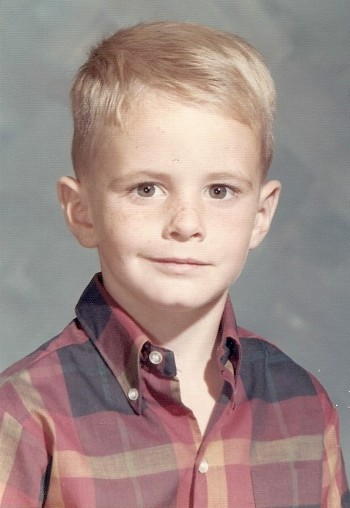 In this original BTB Investigation, we unveil the tragic story of Kirk Murphy, a four-year-old boy who was treated for “cross-gender disturbance” in 1970 by a young grad student by the name of George Rekers. This story is a stark reminder that there are severe and damaging consequences when therapists try to ensure that boys will be boys.
When we first reported on three American anti-gay activists traveling to Kampala for a three-day conference, we had no idea that it would be the first report of a long string of events leading to a proposal to institute the death penalty for LGBT people. But that is exactly what happened. In this report, we review our collection of more than 500 posts to tell the story of one nation’s embrace of hatred toward gay people. This report will be updated continuously as events continue to unfold. Check here for the latest updates.
In 2005, the Southern Poverty Law Center wrote that “[Paul] Cameron’s ‘science’ echoes Nazi Germany.” What the SPLC didn”t know was Cameron doesn’t just “echo” Nazi Germany. He quoted extensively from one of the Final Solution’s architects. This puts his fascination with quarantines, mandatory tattoos, and extermination being a “plausible idea” in a whole new and deeply disturbing light.
On February 10, I attended an all-day “Love Won Out” ex-gay conference in Phoenix, put on by Focus on the Family and Exodus International. In this series of reports, I talk about what I learned there: the people who go to these conferences, the things that they hear, and what this all means for them, their families and for the rest of us.
Prologue: Why I Went To “Love Won Out”
Part 1: What’s Love Got To Do With It?
Part 2: Parents Struggle With “No Exceptions”
Part 3: A Whole New Dialect
Part 4: It Depends On How The Meaning of the Word "Change" Changes
Part 5: A Candid Explanation For "Change"
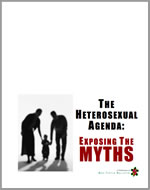 At last, the truth can now be told.
Using the same research methods employed by most anti-gay political pressure groups, we examine the statistics and the case studies that dispel many of the myths about heterosexuality. Download your copy today!
And don‘t miss our companion report, How To Write An Anti-Gay Tract In Fifteen Easy Steps.
 Anti-gay activists often charge that gay men and women pose a threat to children. In this report, we explore the supposed connection between homosexuality and child sexual abuse, the conclusions reached by the most knowledgeable professionals in the field, and how anti-gay activists continue to ignore their findings. This has tremendous consequences, not just for gay men and women, but more importantly for the safety of all our children.
Anti-gay activists often cite the “Dutch Study” to claim that gay unions last only about 1½ years and that the these men have an average of eight additional partners per year outside of their steady relationship. In this report, we will take you step by step into the study to see whether the claims are true.
Tony Perkins’ Family Research Council submitted an Amicus Brief to the Maryland Court of Appeals as that court prepared to consider the issue of gay marriage. We examine just one small section of that brief to reveal the junk science and fraudulent claims of the Family “Research” Council.
 The FBI’s annual Hate Crime Statistics aren’t as complete as they ought to be, and their report for 2004 was no exception. In fact, their most recent report has quite a few glaring holes. Holes big enough for Daniel Fetty to fall through.
“Google” is a trademark of Google Inc.
© Box Turtle Bulletin. All Rights Reserved.

 Posts
Posts  Posts via daily email: